
Twelve12 Architecture + Interior Design
twelve12.design
Beth Halstenson, AIA; Greg Elsner, AIA; Lisa Antenucci
Sirkel Kjøre
Address: 5180 Circle Drive, Edina, MN 55439
Please allow extra time for road closures due to construction and/or local events, particularly W. 66th Street along Rosland Park.
Project Type: New Build
Sponsors: Dwell44 (exterior siding), Erotas Custom Building (builder), Field Outdoor Spaces (landscaping), Synergy Products (windows)
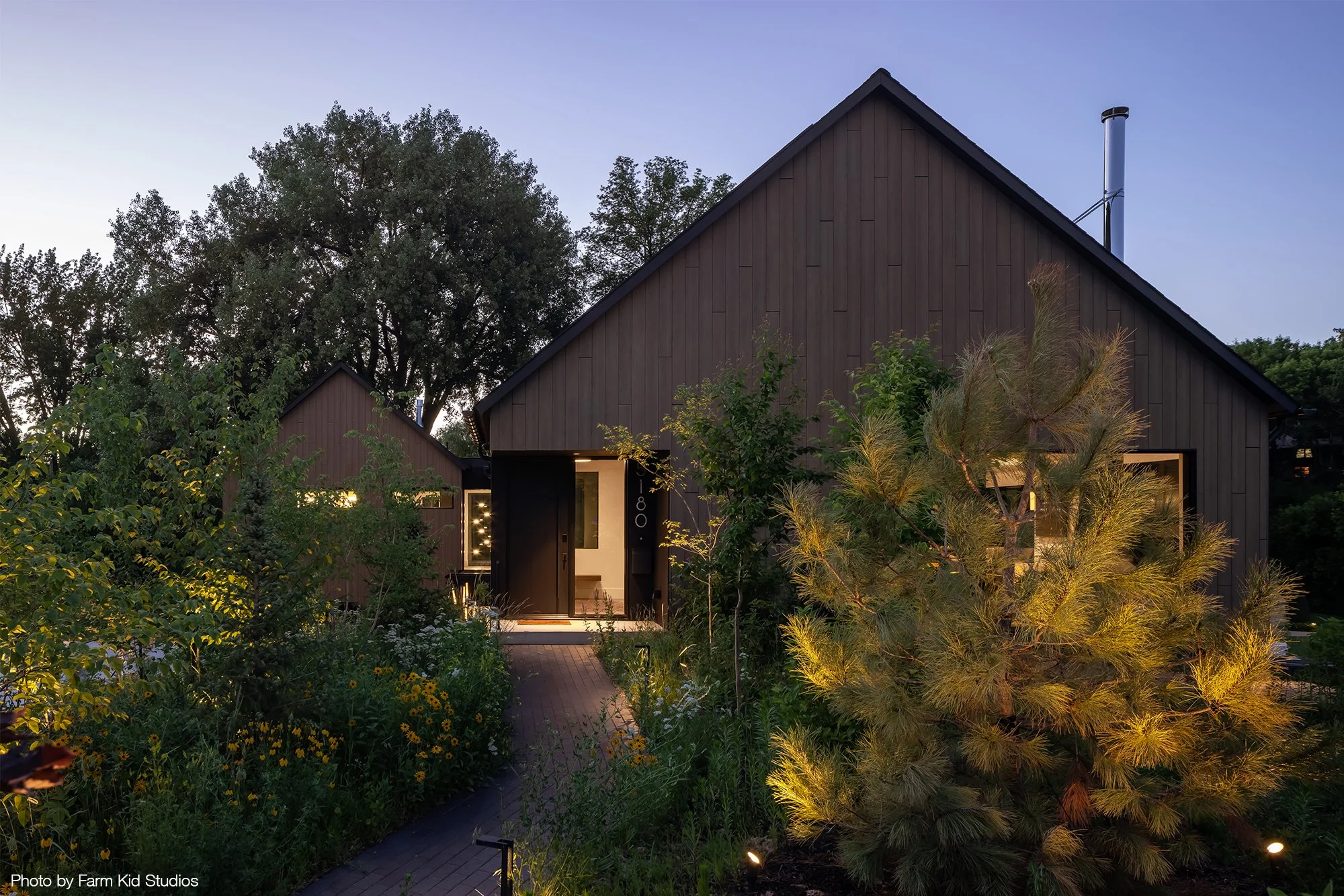
The owners’ request was one-of-a-kind. This retreat is intended for family gatherings, friend nights, music soirées, nonprofit events, cooking demonstrations, and professional retreats. Guest accommodations are organized more like boutique hotel suites than conventional bedrooms, enabling independent use and enhancing the building’s capacity to host events or short-term stays.
The owner’s suite is designed as a lock-off unit, allowing portions of the home to function autonomously as a rental without disrupting primary living spaces. Similarly, a professional-grade kitchen, paired with a large scullery for prep and cleanup, borrows directly from restaurant planning models, enabling seamless operation during large gatherings while maintaining a clean, composed experience.
Materially, the project balances refinement with permanence. Scandinavian design was a starting inspiration but not a rigid constraint. The landscape itself is treated as an extension of the architecture. Extensive site design reinforces privacy and view framing while creating outdoor rooms. A lower-level courtyard serves as a focal point and social anchor, providing sheltered exterior space that complements interior gathering areas and enhances cross-ventilation and daylight penetration.
Collectively, these strategies demonstrate an approach to innovation that is not reliant on novelty alone, but on the precise alignment of materials, systems, and spatial planning. The project leverages lessons from residential, hospitality, and performance design to create a resilient, adaptable environment that is as technically rigorous as it is experientially rich.
Framework for Design Excellence: Design for Change, Discovery, Ecosystems, Energy, Equitable Communities, Integration, and Well-being
Design for Integration: The project is fundamentally an exercise in synthesis, blending residential, hospitality, and performance typologies into a cohesive architectural system. Spatial planning, structural expression, material selection, and building systems are not treated independently; they are coordinated to support flexible occupancy, operational efficiency, and experiential clarity. Early full-scale mockups using on-site scaffolding to study datum, views, and proportion exemplify a design process rooted in iterative, real-world feedback.
Design for Equitable Communities: While privately owned, the project intentionally blurs the boundary between private and public use. Accommodating gatherings, performances, and potential short-term lodging, it creates opportunities for broader community engagement. The inclusion of an elevator and single-level living strategies supports accessibility across a range of users and life stages, reinforcing inclusivity at the building scale.
Design for Ecosystems: The site strategy carefully choreographs relationships to the surrounding landscape. Views are selectively framed to prioritize the adjacent pond while minimizing visual impact from neighboring properties, preserving a sense of immersion in the natural environment. Extensive landscaping and the introduction of a lower-level courtyard create layered outdoor spaces that support habitat, stormwater infiltration, and microclimate moderation.
Design for Energy: Energy performance is addressed through both passive and active means. Building orientation and controlled triple-pane glazing optimize daylight while limiting unwanted heat gain/loss in a cold climate. A high-performance envelope reduces baseline energy demand, while roof-mounted solar panels provide on-site renewable energy generation. These strategies collectively move the project toward lower operational carbon.
Design for Well-Being: Well-being is central to the spatial and material experience. The three-sided glass gathering space provides a strong visual connection to the pond, supporting biophilic design principles. Natural materials, daylight, and carefully proportioned volumes create a calming, restorative environment. The ability to transition between intimate and communal settings also supports social well-being and mental comfort.
Design for Change: Adaptability is one of the project’s most significant contributions. Spaces are deliberately non-prescriptive and supported by operational features such as the scullery, flexible guest suites, and separate owner’s quarters. This allows the building to evolve, functioning as a home, event venue, or rental property, extending its useful life and reducing the need for future renovation.
Design for Discovery: The project reflects a process of exploration and validation. The use of physical mockups to test experiential qualities, combined with cross-disciplinary thinking drawn from residential, hospitality, and performance design, demonstrates a commitment to learning through making. The result is a building that not only resolves a complex brief but also advances a model for hybridized living environments.
What is the AIA Framework for Design Excellence? Learn more »